What to Eat in Cologne: Local Dishes, Where Locals Eat, Kölsch Brauhäuser & the Best Food Tours
The short version: in Cologne, eat a Halve Hahn (a rye roll with a thick slice of aged Gouda, not half a chicken), Himmel un Ääd (mashed potato and apple with fried black pudding), Reibekuchen (crisp potato pancakes) and Rheinischer Sauerbraten, and drink Kölsch in a Brauhaus, where a waiter called a Köbes keeps bringing small 0.2-litre glasses until you put your beer mat on top. Start at Früh am Dom or Peters Brauhaus in the Altstadt, and cross the Rhine to Lommerzheim in Deutz for its famous pork chop. For modern cooking at fair prices, book one of the three Bib Gourmand addresses: HENNE.Weinbar, Capricorn [i] Aries Brasserie or Gasthaus Scherz. And if you only have a weekend, a Kölsch or food tour is the shortcut to the right Brauhäuser and the right orders. Below: what to eat, where to eat it tonight, where to drink, and the experiences worth booking.
Book a Cologne food or Kölsch experience
Short on time? Let a local walk you to the right places.
Our top pick is the Brewery Tour with 3 Kölsch Tastings: 2 hours, rated 4.7 from 3,706 reviews on GetYourGuide.
What to eat in Cologne, and where to eat it
| Dish | What it is | Where to eat it in Cologne |
|---|---|---|
| Halve Hahn | Literally “half a chicken”: a rye roll with butter, a thick slice of mature Gouda, mustard and raw onion | Em Kölsche Boor (with Kölner Mostert, the local mustard); Em Golde Kappes (with cheese aged in-house) |
| Himmel un Ääd | “Heaven and earth”: mashed potatoes and apple with fried Flönz (Cologne black pudding) and onions | Peters Brauhaus; Bierhaus en d’r Salzgass; Deutzer Brauhaus |
| Reibekuchen (Rievkooche) | Grated potato pancakes fried crisp, with apple sauce or on dark rye bread; many Brauhäuser have a weekly Reibekuchen day | Peters Brauhaus (Tuesdays from 17:00); Brauhaus Reissdorf am Griechenmarkt (Wednesdays); Max Stark (Tuesdays from 17:00) |
| Rheinischer Sauerbraten | Beef marinated for days in vinegar and spices, braised and served in a sweet-sour raisin gravy with potato dumplings and apple sauce | Brauerei zur Malzmühle; Früh em Veedel; Haus Töller |
| Kotelett mit Schmorzwiebeln | A thick pork chop with slow-braised onions, the cult order on the east bank | Lommerzheim; Brauhaus ohne Namen |
| Hämmchen and Haxe | Pork knuckle: Hämmchen is cured and boiled, usually with sauerkraut and mash; Haxe is roasted | Haus Töller (known for its Hämmchen); Brauhaus Päffgen (Bierhaxe) |
| Grünkohl mit Mettwurst | Kale stewed with smoked sausage, the winter plate of the Rhineland | Brauhaus Päffgen |
| Muscheln and Martinsgans | The autumn and winter specials: mussels cooked Rhineland style, and roast goose from St Martin’s Day (11 November) | Max Stark (goose from St Martin’s, mussels from November) |
Where to eat in Cologne
The rule for eating well in Cologne: go to a Brauhaus. Each one pours a single brand of Kölsch, many brew it themselves, and all of them serve the same hearty Rhineland kitchen at long shared tables. Food comes in big portions at moderate prices, and weekday lunch and the Reibekuchen days are the best value. Book at weekends for the popular houses, or arrive early. One date to know: on 11 November at 11:11, Cologne opens its carnival season, and the Brauhäuser in the old town are packed from the morning; Früh am Dom posts special hours for 10 and 11 November.
Altstadt around the Dom
Between the cathedral and the Rhine are the most famous Brauhäuser in the city. Früh am Dom, opposite the cathedral since 1904, has a rustic ground floor, a medieval vaulted cellar with its own bar and a glass-roofed courtyard in summer; book online. Gaffel am Dom, on the square in front of the main station, is open seven days a week until late and shows football. Towards the river, Peters Brauhaus is a family-run brewery pub known for Himmel un Ääd, with Reibekuchen in several styles on Tuesdays from 17:00. On the Heumarkt, the Brauerei zur Malzmühle has brewed Mühlen-Kölsch for more than 150 years: order the Sauerbraten with dumplings and apple compote. On the Salzgasse, the wood-panelled Bierhaus en d’r Salzgass pours Päffgen and serves Himmel un Ääd daily until late, and Sünner im Walfisch pours Sünner Kölsch in a stepped-gable house.
For a modern dinner by the cathedral, maiBeck is in the MICHELIN Guide (Michelin listing) for modern cooking from carefully chosen ingredients, with a four-course “Für Dich” menu and a terrace between the Dom and the Rhine; it opens Tuesday to Saturday for lunch and dinner. Its Italian sister OTTO für dich is also in the guide (Michelin listing), and the inspectors single out the pasta. North of the station, in the Eigelstein quarter, Em Kölsche Boor is one of the city’s oldest Brauhäuser, with Halve Hahn, Sauerbraten and two bowling lanes in the cellar, and Max Stark pours Päffgen, is known for its fried potatoes and is busy enough that you should book.
Belgisches Viertel, Friesenviertel and the Kwartier Latäng
West of the old town, the Belgian Quarter is Cologne’s café and restaurant district, and the streets around it have some of the best Brauhäuser. Brauhaus Päffgen on Friesenstraße still brews by hand and is the address many locals name first: Bierhaxe, Grünkohl with Mettwurst, a three-quarter-metre Bratwurst, and a beer garden with a roof that closes for winter; it opens daily from midday. Nearby, HENNE.Weinbar holds a MICHELIN Bib Gourmand (Michelin listing): a short lunch menu on weekdays, known for its schnitzel, then seasonal sharing plates in the evening, from Monday to Saturday. In the quarter itself, Bar Brio is in the MICHELIN Guide (Michelin listing) for bold, seasonal sharing plates, and C.C. Kowalski cooks regional, seasonal German food at fair prices, Monday to Saturday. South of the Rudolfplatz, in the student quarter, Brauhaus Pütz pours Mühlen-Kölsch from the cask to a younger, less touristy crowd, and Haus Töller, in one of the oldest buildings in the city, is the place for Hämmchen and Sauerbraten, with Reibekuchen on Fridays from 17:00 to 20:00; it opens Monday to Saturday from 17:00.
Ehrenfeld
The former industrial quarter west of the ring is Cologne’s creative district, multicultural and young. Braustelle is the city’s smallest brewery, brewing since 2001 and pouring its own beers, from the pale Helios to a hibiscus beer called Pink Panther, with fried potatoes in Altbier sauce and beer goulash; it opens Tuesday to Saturday from 18:00. On Venloer Straße, Haus Scholzen is a traditional house pouring Gaffel, known for its Ehrenfelder Senfrostbraten (roast beef with a mustard crust); it opens Wednesday to Sunday, and the kitchen closes between lunch and dinner. For a modern evening, Kluth is in the MICHELIN Guide (Michelin listing): two former Ox & Klee chefs cook a six-course surprise menu from seasonal, organic produce, with a vegetarian version. Book ahead.
Südstadt
The south of the old town, around the Chlodwigplatz and the Severinsviertel, is Cologne at its most local. Früh em Veedel is the neighbourhood branch of Früh, serving Sauerbraten with dumplings, Sahnehering (herring in cream sauce) and Eisbein (pork knuckle); it opens weekday afternoons and from 11:00 on Fridays and Saturdays. Johann Schäfer, in a former 1920s depot, is the modern Brauhaus: it brews its own Südstadt-Pils and cooks seasonal, regional food with plenty of vegan options. On Alteburger Straße, Capricorn [i] Aries Brasserie holds a MICHELIN Bib Gourmand (Michelin listing) for down-to-earth French brasserie cooking, such as house-made venison ham, duck liver terrine and steak frites; it opens Tuesday to Saturday from 18:00, booking is advised and cards are not accepted. Phaedra is in the MICHELIN Guide (Michelin listing) for Mediterranean cooking with Greek touches and house-made mezze, Wednesday to Saturday evenings. And for a special night, Pottkind holds one MICHELIN star (Michelin listing), with counter seats over the open kitchen.
Deutz
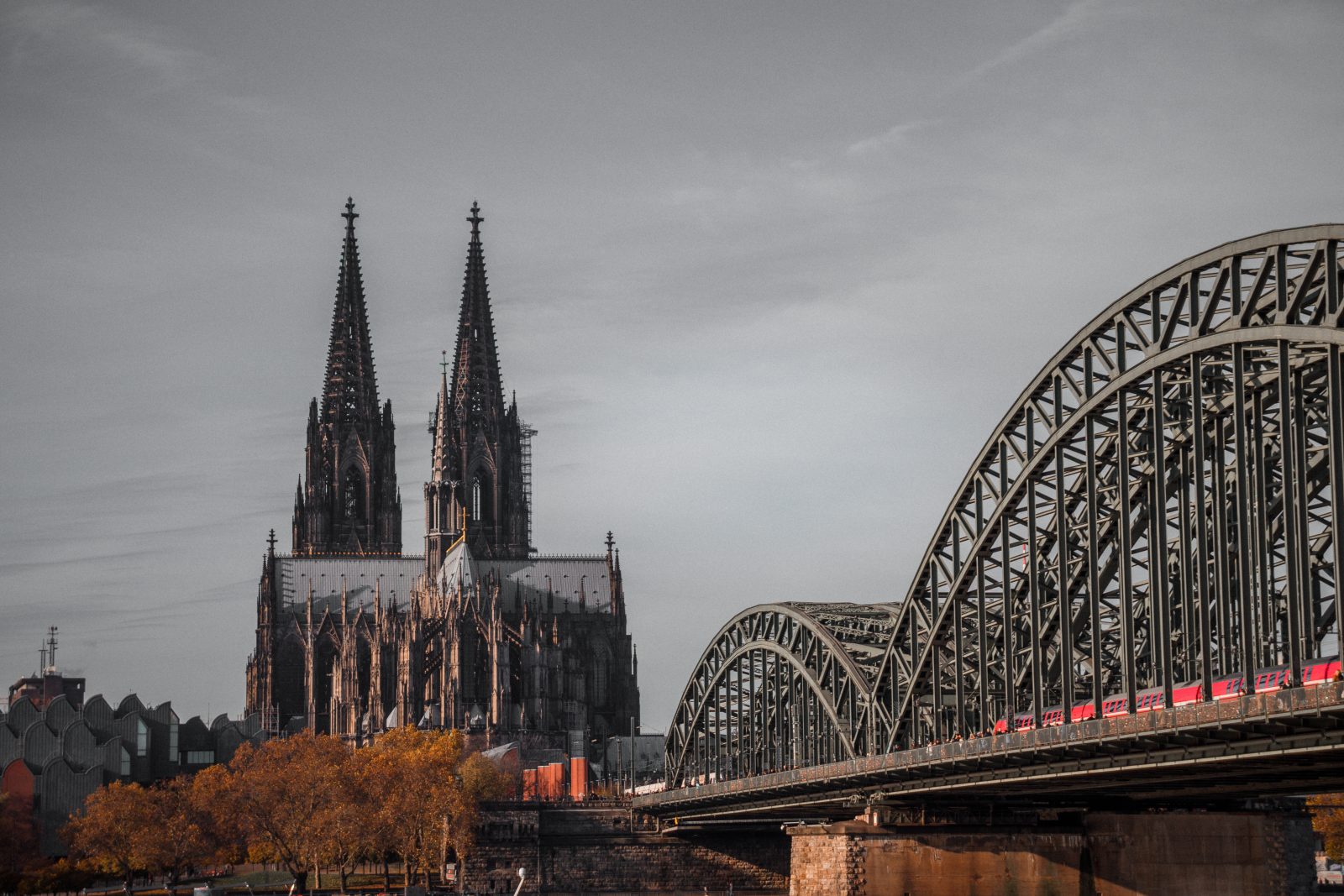
Across the Hohenzollern Bridge, the east bank (the “Schäl Sick” to locals) has the best view of the cathedral and one of the most famous Brauhäuser in the city. Lommerzheim pours Päffgen and is known for its Kotelett with braised onions; queues often form in the afternoon, so come early, and note that it is closed on Tuesdays and closes between lunch and evening service. Brauhaus ohne Namen serves knuckle, a Braumeister-Kotelett and Käsespätzle with young, friendly staff instead of classic Köbes; book at weekends, and expect it to open an hour before kick-off on FC home match days. The Deutzer Brauhaus, in Deutz station, is the easy stop after the trade fair or the arena: Himmel un Ääd, Sauerbraten and Reibekuchen, open daily. And Haus Zeyen pours Sion Kölsch with steaks, schnitzel and Kotelett, Tuesday to Sunday evenings.
Quick picks
- Classic Brauhaus night: Früh am Dom or Peters Brauhaus in the Altstadt, Päffgen on Friesenstraße.
- Cheap and fast: a Halve Hahn or a Reibekuchen day at Peters, Reissdorf or Max Stark, or the weekday lunch at HENNE.Weinbar.
- Special night: Pottkind in the Südstadt for one star, or Austrian classics such as Tafelspitz and Wiener schnitzel at Bib Gourmand Gasthaus Scherz (Michelin listing), a short tram ride south-west of the centre.
- Best for the signature dishes: Lommerzheim for the Kotelett, the Malzmühle for Sauerbraten, Peters for Himmel un Ääd.
Names link to Google Maps for directions. We checked these places in October 2026. Opening days change, especially out of season, so check before you go.
The markets
Cologne has no single central market hall; it shops at its weekly street markets. The biggest is the Nippeser Wochenmarkt on Wilhelmplatz in Nippes, about 3,000 square metres of stalls and the only market open almost every day: Monday to Friday from 7:00 to 13:00 and Saturday until 14:30. In the centre, the market at St. Aposteln by the Neumarkt runs on Tuesdays from 7:00 to 13:00 and Fridays until 14:00, with delicatessen and baked goods. On Thursday evenings from 16:00 to 21:00, the Markttreff Rudolfplatz is an after-work market with food trucks and winemakers pouring their wines. In Deutz, the Wochenmarkt Deutzer Freiheit sells regional sausage, cheese, fruit and vegetables on Friday mornings. And on Saturday mornings, the Braunsfelder Wochenmarkt by the Stadtwald has the long queue at Heinz’s Reibekuchen stand.
What to drink in Cologne
Kölsch, and the rules that come with it. Kölsch is a light, pale, top-fermented beer that may only be brewed in the Cologne area, and it is served in a Stange, a slim, straight 0.2-litre glass, so it is always fresh and cold. The waiter in a Brauhaus is the Köbes, who carries the glasses in a round tray called a Kranz. You do not order the next one: when your glass is empty, the Köbes swaps it for a full one and adds a pencil mark to your beer mat. To stop, put the beer mat on top of your glass. At the end, you pay for the marks. Each Brauhaus pours one brand: Früh, Gaffel, Peters, Mühlen at the Malzmühle, Päffgen, Reissdorf, Sünner and Sion are the names you will see on the doors. Two brewers to taste at the source are Päffgen on Friesenstraße and the Malzmühle on the Heumarkt; for something different, Braustelle in Ehrenfeld and Johann Schäfer in the Südstadt brew their own beers outside the Kölsch tradition. At Hellers on Roonstraße, ask for the house herbal liqueur, the Kallendresser.
Then wine. Cologne sits on the Rhine, and the Riesling country of the Middle Rhine and the Mosel is close: see our guide to Mosel vs Rhine Riesling. To drink well in the city, HENNE.Weinbar sorts its list into #classic, #freakshow and #icon. Die Bredouille in the Belgian Quarter has ten wines and six sparkling wines by the glass, cheese and charcuterie boards and after-work tastings, from late afternoon. Frohnatur Bar pours natural wines, mostly from German growers, on Tuesday to Saturday evenings. In the Südstadt, Maulvoll is a former wine shop turned wine bar, recognised by Gault&Millau, with concerts on Wednesday evenings, and Alvinha is a coffee bar by day and an enoteca with Italian and Portuguese wines and cicchetti by night.
Food experiences to book in Cologne
Cologne’s food culture lives in its Brauhäuser, and each one is different: its own Kölsch, its own Köbes, its own house dish and its own Reibekuchen day. A Kölsch or food tour pays off on a short visit: a local guide takes you through three or four Brauhäuser in the old town in a few hours, explains the beer-mat rules and orders the right plates, from Halve Hahn to Himmel un Ääd. A brewery tour or a Rhine wine day are good alternatives. These are the best-rated options on GetYourGuide.
| Experience | Length | Rating (reviews) | Best for | Book |
|---|---|---|---|---|
| Brewery Tour with 3 Kölsch Tastings | 2 hours | 4.7 (3,706) | Kölsch | Check availability |
| Südstadt Culinary Food Tour | 3 hours | 4.5 (677) | Food | Check availability |
| Kölsch and Brauhaus Tour | 2 hours | 4.6 (754) | The Brauhäuser | Check availability |
| Kölsch Brewery Tour with a Master Brewer | 2 hours | 5.0 (65) | A smaller group | Check availability |
Our pick: the Brewery Tour with 3 Kölsch Tastings, rated 4.7 (3,706) on GetYourGuide.
Ratings as shown on GetYourGuide in October 2026. Check the listing for live prices and availability.
Food day trips from Cologne
The best food day trip from Cologne is up the Rhine into wine country. The Middle Rhine, with its steep vineyards and castles, and the Mosel valley, with its slate-soil Riesling, are both within reach for a day of tastings, by train or on a guided tour. See our Rhine Valley wine tours and Mosel wine tours.
Frequently asked questions
What is the one dish to eat in Cologne?
Himmel un Ääd, mashed potato and apple with fried black pudding, at Peters Brauhaus or the Bierhaus en d’r Salzgass in the Altstadt. For a snack with your Kölsch, order a Halve Hahn; for a full meal, the Sauerbraten at the Malzmühle.
How does ordering Kölsch work?
You do not order each glass. The Köbes brings a fresh 0.2-litre Stange as soon as yours is empty and marks your beer mat. When you have had enough, put the beer mat on top of the glass, then pay for the marks.
Where do locals eat in Cologne?
In the neighbourhood Brauhäuser: Päffgen on Friesenstraße, Lommerzheim in Deutz, Früh em Veedel in the Südstadt and Haus Scholzen in Ehrenfeld, and at the Nippes market on Wilhelmplatz on a weekday morning.
Do I need to book in Cologne?
For the popular Brauhäuser at weekends, yes, or arrive early: book Max Stark, and Brauhaus ohne Namen at weekends; at Lommerzheim, come early and queue. Book Capricorn [i] Aries, Kluth and the starred restaurants in advance. During carnival, from 11 November and above all in the week before Lent, expect the old town to be full.
Where can I eat cheaply in Cologne?
On a Reibekuchen day at Peters (Tuesdays), Reissdorf am Griechenmarkt (Wednesdays) or Haus Töller (Fridays), with a weekday lunch at HENNE.Weinbar or Reissdorf, or with a Halve Hahn and a Kölsch in any Brauhaus.
Is a Cologne Kölsch or food tour worth it?
Yes, if you have a day or two: in a few hours you visit several Brauhäuser, taste the classics, learn the Kölsch rules and know where to go back to. Compare them above.
Plan your Cologne food trip
Cologne Kölsch and food tours · Rhine Valley wine tours · Mosel wine tours · Cologne Christmas markets: what to eat and drink · Mosel vs Rhine Riesling